Showing posts with label acupressure. Show all posts

Friday, January 24, 2014

Yintang - Acupuncture Point

I learnt from this article that yintang is "a single point located between the eyebrows, just below the area known as the third eye", and it is used in acupuncture to calm the mind and "for anything head and face-related, especially issues with the nose".

I also learnt from this article that we can apply self-acupressure on the yintang. 
 http://taoism.about.com/od/Acupressure_Treasures/a/Yin-Tang.htm
"To apply acupressure to Yin Tang, bring the first and middle fingers of your two hands together, using the ends of those four fingers, in concert, to very gently, in a circular motion, massage the area between the inner ends of your two eyebrows. The motion can be either clockwise or counter-clockwise (find out which intuitively feels best to you). As you apply that circular acupressure/massage, allow all the muscles of your forehead to soften and relax (saying "ahh" can be useful here), as though they were releasing backward, in the direction of the center of your skull (the upper dantian area)."
When googling "yintang acupuncture youtube", I came across this fun and edutaining video on the extra points in acupuncture, including the yintang point.
http://www.youtube.com/watch?v=IxEPv0jEFWw

 I also find this information on this related article useful regarding how yintang or the pineal gland can be stimulated to secrete the hormone melatonin which makes us sleepy.  
http://cuppingforlife.blogspot.sg/2011/11/yintang-most-requested-acupuncture.html

"The location of this acupuncture point corresponds to the third eye, a metaphoric eye in Hinduism and Buddhism that opens as our consciousness expands and we become enlightened. It is the location of the brow chakra, the 6th of 7 major energy vortexes that exist in our bodies, which has to do with inner guidance, mental clarity, and intuition. Even in western medicine this is an anatomically important location, where light enters the skull to activate the pineal gland. As darkness increases in the evening, the pineal gland is stimulated to secrete the hormone melatonin, which makes us sleepy. As the sun comes up and light increases, the pineal gland stops producing this hormone and we wake up."
This article says that research results showed "similarities measured in the human brain both under sedation using yintang and sedation using anesthesia." 
http://healthystuffu.com/acupuncture-point-yintang-the-third-eye-6th-chakra/
"The journal Medical Acupuncture published a 2005 study entitled “Shenting and Yintang: Quantification Of Cerebral Effects Of Acupressure, Manual Acupuncture, and Laserneedle Acupuncture Using High-Tech Neuromonitoring Methods,” by Gerhard Litscher, MDsc. The study was about the electroencephalographic similarities of acupressure induced sedation and general anesthesia, as assessed by bispectral index and spectral edge frequency. Read the study here. The basic result showed similarities measured in the human brain both under sedation using yintang and sedation using anesthesia."

Sunday, November 17, 2013

Alleviating pain and enhancing beauty with acupressure

According to this informative article, there are seven key acupressure points that can be stimulated using the fingers to bring about the body's natural self-curative abilities. I learnt that these acupressure points are Zu San Li, Tai Chong, San Yin Jiao, Yang Ling Quan, Nei Guan, Lie Que and He Gu. 

TAI CHONG (Liver 3)

I decided to google some of these acupressure points to find out if there are pictures showing their specific locations in the body, and I find the diagram in this website useful to identify where Tai Chong is and I learnt it is also known as Liver 3. 
 http://acutakehealth.com/why-are-you-doing-that-point-lv3-li4
"Liver 3—also known as Taichong (Chinese name), Great Rushing (English translation) and LV3 (acupuncturist lingo)—is located on the foot, between the first and second toes.
Liver 3 is what’s known as a source point. Every meridian has one. Source points behave sort of like central stations on subway lines. They are hubs where internal and external energies gather and transform. They are single, high-concentration points that grant access to the larger system.
Because Liver 3 has such far-reaching effects, it is indicated for a very wide variety of conditions. John Pirog, in The Practical Application of Meridian Style Acupuncture, says Liver 3 is “probably the most important point for stagnation of the inner body.”
Liver 3 is used for menstrual cramps, headaches, vision problems, coastal-region pain and shortness of breath, low back pain, insomnia, and more. The list truly goes on and on. Feeling stuck? Hello, Liver 3. This point gets things moving.
Liver 3′s extensive effects are palpable. Needling it usually causes a strong achy sensation, either locally at the site of insertion, throughout the entire foot, or sometimes even up into the leg along the Liver meridian."
NEI GUAN

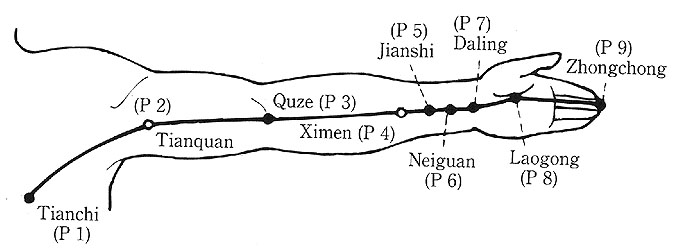
I also find the diagram in this website helpful to locate Nei Guan around the wrist.
 http://www.diyacu.com/self-acupuncture-blog/all-about-the-neiguan-acupuncture-point.html
"Altogether, the Neiguan point is renowned to help to treat and manage:
  • Sickness and nausea
  • Chest and abdominal pains and problems
  • Angina
  • Stomach problems and upsets
  • Inflammation of the pericardium
The Neiguan acupuncture point is a very “balancing” point, which is why it can have a positive effect on a wide range of complaints and conditions that involve relaxing the muscles, such as those in the diaphragm and the chest."

HE GU (Large Intestine 4)

As for He Gu, I learnt that it is also known as LI4 (or Large Intestine 4), which can be stimulated to bring relief to pain and stress. 
"Chinese Name: Hegu (English translation: Joining Valley)
Location:  On the dorsum of the hand, between the 1st and 2nd metacarpal bones, in the middle of the 2nd metacarpal bone on the radial side."

LIE QUE

Lie Que: Relieves sadness, grief and depression. The vibrant magnetic aspect of a woman suffers most from these emotional issues. Poor posture, respiratory problems, and various skin conditions may be prevented with the use of this point. The Lie Que point is located on the thumb side of the wrist, beside the head of the radial bone (just below the base of the thumb) approximately one inch from the crease of the wrist (toward the elbow).

Notes on Inner Qi seminar

Inner Qi seminar Aligning your sub-conscious for health, wealth and happiness - Master CK "Yellow emperor's inner classi...